


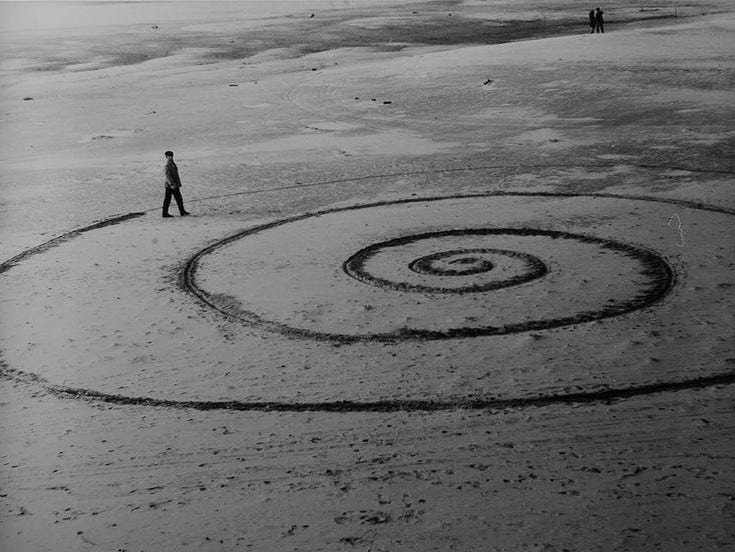
A baby elephant arrives at the circus.
A collar is placed around its neck. The collar is attached to a rope which itself is attached to a heavy, metal stake hammered into the ground in the centre of the ring.
The elephant, young, weak, and unable to break the rope or pull the stake out of the ground, concedes to walking in circles around the stake, day in and day out.
The elephant grows. And grows. And grows.
Eventually, the elephant becomes strong - able to crush a car with one foot, or knock down the wall of a house with one nudge.
Despite this strength - and the fact that, at any time, it could snap the rope or pull up the stake - the elephant continues to walk in circles.
The elephant, in the face of all evidence to the contrary, still believes that the rope can hold it back - and, so, it never tries to break free.
I love this story. It says a lot. About elephants. But, maybe more so, about us, and how no matter how much we “know”, we can still carry beliefs that hold us back from the things that we can, in fact, do and accomplish.
I will confess - I fell into this trap in my own career. I’m not bragging, but - I was an excellent lawyer. The best? I don’t know - I doubt it. But I was good at what I did.
I didn’t really love it though.
And, like a marriage that is amazing on paper, but is “meh” in your heart, that can be really dangerous. (For the record, my marriage is wonderful - but I digress).
Like many others I’ve met over the years, I also believed that not only was being “good” a reason on its own to stick with it, but also, because, being “good” made it all the less worthwhile to do something else.
Being “good” was the rope - the thing that I believed, wrongly, was holding me back from taking a chance and doing something different.
And, when you’re good at something - when you know how to navigate the challenges, anticipate the pitfalls and accomplish really hard things in the work that you are called to do as a part of that job - you get really good at muscling through the miserable parts. Or, in other words, you start to forget that there is a rope.
Research actually shows that high performers suffer long because they can tolerate more. People selected for leadership (“high performers” in their own right) tend to display higher stress tolerance even before assuming the role. But, crucially, they also experience significant stress because of the demands and constant threats inherent to those positions - and through which they need to push through.1
So, why do people stick with it then? Even when they are good at something that they might absolutely hate doing - even when they know that, in the short or long term, sticking with it is ultimately not good for them - why do they push through?
A few reasons to consider:
Praise. Yes, no matter how much we might dislike our work, it still feels good to be praised for doing a good job.
Promotions. Not only does progress = praise. But, as we move “up” in our world of work, we can very easily come to believe - when I get “there”, it will be better - so, no reason to change it up now.
Respect. If we are doing something we are good at, we are respected by others (or, respect ourselves) for our skill - in spite of (or perhaps, because of) the fact that we are suffering doing it.
The Sunken Cost Fallacy. “I’ve already put so much time, energy, effort, reputation and life into this that I’ll never be able to make that up elsewhere,” or, more commonly, “It’s too late to start again.” Need I say more?
Golden Handcuffs. Disguised as professional validation, on the surface this is the sense that it’s worth it on a monetary basis to stay where we are - to be a “bird in the gilded cage” if you will. You’d be dumb to leave something so well paying, even with the misery that entails. Under the surface, the “handcuffs” are really psychological - escaping from their grip entails losing more than money. The identity and prestige that can be tied up (no pun intended) in the “golden handcuffs” is a loss many are not willing to endure.
Identity scaffolding. The psychological structure that forms around your work (and not just from it), it’s everything your job subtly holds up so you can avoid asking the harder questions. Questions about your social legibility, or your worth, or the coherence of your own personal narrative. Even questions about the future. Questions that, without asking, often lead to, “I don’t even know who I’d be without this job.”
Let me be clear - none of these reasons are bad or wrong. In fact, they are all perfectly fair, understandable, even logical reasons to stay where you might be. And, I should add - it’s entirely unfair to judge someone for their reasons, whatever they might be, to not make a major (or even minor) career shift.
But - even with the fairness of reasons - it’s hard to deny there is still a cost to staying good.
For starters, when you are good at something, it gets really easy to stop asking if you like it. You start to replace your desire for a task with your own excellence at that tadsk.
Like being in a really hot sauna. Yes, I am good at being in a sauna for a long time. Is it enjoyable at minute 23? No. Am I considering how much I am enjoying it in that moment? No. I am just focused on getting to the next minute. (I realize now that I’ve written this out how insane this might sound).
That’s not to say that there isn’t enjoyment out of doing really hard things. I am sure many of you have felt the satisfaction of having closed out the worst, most painful deal closing that you truly thought would never end.
It’s just that - your career is not a sauna session. Or a marathon. Or a boxing match. Or even a deal closing.
All of those things are short-term and you can almost always see the end of those from where you are (regardless of whether you are enjoying them or not).
But, a career? Not as easy. Especially one that consumes your identity.
Really, this is all a long winded way of saying that, when we are good at something that we don’t really enjoy any longer, we start to think, “If I’m this good at it, I should enjoy it.”
And what do you lose when you start saying that?
You lose curiosity - you are bored with what used to interest you, and you start to convince yourself you are burned out (instead of just getting curious about something else).
You lose appreciation for your work - you resent the role while you convince yourself it’s your duty to be doing it (instead of admitting that you owe yourself a duty to find something you do appreciate).
You lose your sense of real stability - trading in the low risk of a plateau for the balance you would likely feel if you were experimenting with something truer to you.
And, perhaps above all, you deny yourself the pride of pursuing the thing that means most to you, not on paper, or reputation-ally, but in your bones.
The upside of all of this is that, when you realize the costs, you can start to actually do something about it.
I know I did. And, it entailed the following (in order):
[Note: Interestingly, the research confirms that this is actually a normal sequence of events for those of us who go through major career or role changes (despite it feeling completely abnormal). So, if you are contemplating something similar, get ready.]
Ego Withdrawal. This happens when the external mirrors that used to confirm who you are go quiet. For me, this is when I check my emails and realize, “Oh, no one is hounding me for anything right now.” Less urgency. No one needs me in the same way. This can also often be experienced as a strange flatness or a loss of edge. This is when the things that reinforced your identity go missing - and you don’t know what to do with that. This identity discontinuity is often associated with challenges in life satisfaction and adjustment, indicating real internal work during transitions.2

Panic. Then comes the “Oh, shit” moment. The moment you think, “Uh oh. I made a HUGE mistake.” This makes sense. You just jumped out of a plane, but the parachute hasn’t opened … yet. So, you go through all the usual thoughts of, “I can go back, right?” and, “What is wrong with me?” and of course, the best, “Man, life was perfect, so why did I do this?”
What’s actually happening is this:
Your nervous system has lost its predictive model
Your brain is scanning for certainty
Old identities start yelling because they know how to survive
You are fundamentally having a threat response. And, so, if you treat this as panic time, then you look for safety. You go back. And, a lot of people do this. And that’s OK.
But, if you try to navigate this through intuition, the parachute opens. There is a chance to slow down and find direction.
If we think about this as a “liminal” phase, the research frames these types of transitional periods as moments of suspended coherence, where individuals are neither fully in their old life nor fully into a new one - an experience marked by disorientation and, of course, panic.3
Space. If and when you do slow down, something weird happens. And, I think, this is the most under-appreciated part - you get some space.
To be clear - this is not peace. You will be bored. You will go on really long walks. You will have meandering thoughts. There will be emotions that arise, and you wonder, “Where the f*ck is that coming from, and why?”
But, you’ll have the room for all of it. And, that’s a good thing.
This is also the time where you might allow some grief to surface over lost opportunities or projects or ideas. Curiosity will start to re-emerge. Things you ignored now get the attention they likely originally deserved.
For those of us who are high performers, this phase is really hard because, by external standards, it is really quiet. It is “unproductive”. And that is hard when you have spent so long being über-productive.
And, so, most people try to rush this part for, if no other reason, to feel like they are doing something.
That’s a mistake. Probably a necessary one, but a mistake nonetheless.
Work-related identity loss and career transitions often involve a period of ‘identity sense-making’ where individuals experience confusion and emotional difficulty as they reconcile their past identity with emerging possibilities. So, like a fine wine, you have to give it the time it needs to breathe - otherwise, it will just take like alcoholic grape juice (read: not good).4
Rediscovery. This part isn’t reinvention. It’s remembering.
For me, this was recalling things that I used to enjoy (including as a kid). The values that I used to hold highest before they got sidelined for other stuff. The questions I used to ask but lost the time for. Even memories that resurface after so many years of staying dormant.
At this point, people often say:
“I haven’t thought about this part of myself in years.”
“I used to love this.”
“This feels… familiar.”

It’s sort of like looking at the rings of a tree - where you can see the rings closer to the core and remember, “Oh, yeah, that was the year of the drought.” Or, “Yes, that’s the year that we carved our initials into it.” You see the evidence of what was around before you got to where you are.
That’s important information. So don’t disregard it.
But, also, don’t think this is you going back to your glory days in high-school,. Because, you aren’t. This isn’t regression.
I think a lot of folks think that, when you get to this phase, you are just becoming more immature - and instead of you re-discovering aspects of yourself, you are really having a midlife crisis, subsequent to which, you’ll leave your partner and children, go to Burning Man, discover house music and MDMA, and then come back and live as a mediocre, has-been professional who moonlights as a DJ.
Not that there is anything inherently wrong with that.
But, that’s not the point. The point is that this mistakes regression for integration of earlier self-states that never really got to be expressed. This phase is not getting about smaller - it’s actually about getting bigger.
Integration. This is where it all comes together - literally. Where you stop needing to look elsewhere - money, prestige, title, etc., to confirm your identity. In other words, the work reflects you - and not the other way around.
Sounds nice, right? So, what’s changed?
Decisions feel slower but cleaner
Status matters less, meaning matters more
You can tolerate ambiguity
You bring worth to the role.
Is this a quick process? God, no.
Will it feel like you are going in circles? Probably. It takes a long time to realize that the rope isn’t really strong enough to hold you back from getting through this. It may take a few efforts.
But, is it worth it? Absolutely. Because, there is nothing more expensive than being exceptional at the wrong thing.
But, when you are exceptional at the right thing? Well, you tell me.
Have something to say? Send me a note here.

→ Let me know which topics, challenges or thinkers I should write about next. Reply or comment and tell me what you’d love to learn more about.
→ Connect with me on LinkedIn - I share more thoughts like these there.
Harms, et al. The Leadership Quarterly, Volume 28, Issue 1, February 2017, Pages 178-194.
Vignoles, V. L., et al. (2021). Identity continuity and psychological well-being: A meta-analysis. Personality and Social Psychology Review, 25(2), 97–130.
Carleton, R. N. (2016). Fear of the unknown: One fear to rule them all? Journal of Anxiety Disorders, 41, 5–21.
Turner, V. (1969). The Ritual Process: Structure and Anti-Structure. Aldine Publishing.
Wow, it's like you're living my life right now. Spot on and beautifully written, as usual!