


Well, it’s 2026. Another year in the books. And, on that note, I hope that this one is off to a good start for you, dear reader.
And with the new year, of course, come resolutions.
I never really did the whole “new year’s resolution” thing.
I always figured - if there is anything I really care about doing, either: a) I don’t need a new year to commit to it - I’ll start it when the idea arises; b) I am already doing it and don’t really need to resolve to do it at all; and/or c) it’s not important enough to resolve to do on the impetus of a new year, so, when the schedule permits, then I will start making a new habit of this thing I am apparently going to resolve to do.

So it’s interesting to me that I am writing an article about new year’s resolutions at all.
And, that I actually have one this year.
The word “resolution” is built from two primary Latin components:
re-: A prefix meaning “back” or “again.”
solvere: A verb meaning “to loosen,” “to untie,” or “to release.”
In its original Latin context, resolutio referred to the process of reducing things to their simpler forms or “unbinding” a knot.
But, in today’s day and age, and especially around this time of year, it is almost inversely defined as, “to get more done.”
And, while this has nothing to do with the etymology of the word, and everything to do with something I have more or less been avoiding forever, I am going to aim to resolve to do less this year.
And, I don’t mean “do less” as in “be bored like these influencers in order to inspire creativity, but also (and perhaps moreso) to attract more followers and, thus, do more.”
I mean something more like the definition of “resolution” - to loosen my grip, as it were. I’ve started to wonder whether the problem isn’t that I do too much - but that I try too hard while doing it.
But, how does one make that distinction a reality?
How can one achieve the goal of doing less without, actually, doing more? Isn’t there some sort of action, or set of instructions, or self-improvement book that I could read which will help me do less?
Probably. Yes. Here is one.
In what will surprise no one, there is an entire industry that, unironically, gets you to work very hard at trying less.
Which is why it’s so frustrating to have been on the receiving end of this advice for so many years. And, I get it. I do seem to always be doing something - or at least planning on doing something, or striving to get something done.
And, I think that last part is really the rub. The striving. The need to feel as though I have accomplished something and the only way to do that is to exert more, not less, effort. Measuring my effort in terms of inputs, not outputs.
So, perhaps this has nothing to do with doing less at all - but rather, trying less. Putting in less input, and still aiming for the same, if not more, output. Loosening the hold on what is going in and trusting that what will come out will still be good.
Thought about it this way, the resolution changes: Keep up my level of activity, but in a way that is less draining on my psychic energy, less dependent on trying, less reliant on adding energy into a system that is already overloaded.
When we add energy to a full system, the energy has nowhere to go. And, so, it’s wasted. And, so, I (or we) get tired.
It’s exhausting not because the work is hard, but because, the excess energy we’re putting in is being reallocated to supervision. More specifically, the constant supervision of ourselves while doing whatever it is we’re doing. To make sure we’re optimizing energy. To confirm we’re on track. To be certain that we are aligned with what we think we’re supposed to be doing.
Or, maybe the exhaustion comes from trying to earn our right to be here through effort. Maybe as Oliver Burkeman has said, the problem isn’t that we don’t have enough time. It’s that we try to use time to justify our existence.
Does this sound familiar? It’s funny to say (or at least, write) this out loud. Because, I have been told that this is fundamentally what I help people do in our work together: Try less but somehow get more done.
Even though I still really have no idea how to do less. Maybe I’m not even built to do less. But, I certainly know I can try less.
It’s not like there is some taskmaster sitting beside me telling me, “Jordan, do more. It’s 2026, you are 43 years old, you still haven’t accomplished half of what you want to, and yet, you are writing a Substack. Have you lost your mind?”
I hope not. And yet, I might have when I remember again that no one is actually forcing me to push this hard.
This is where the words of Byung-Chul Han come to mind: we are no longer oppressed by external forces but by internalized pressure to optimize ourselves.
Well, that’s great.
But, that still hasn’t answered the question of “How?” that I left hanging above. But, now that we have a new definition of what it means to “do less” (read: “try less”), answering the “How” of it all seems, well simpler.
Step 1: Don’t try to answer the “How” at all.
That’s it. That’s the system.
This doesn’t mean ignore the question. It also doesn’t mean to become a nihilist.
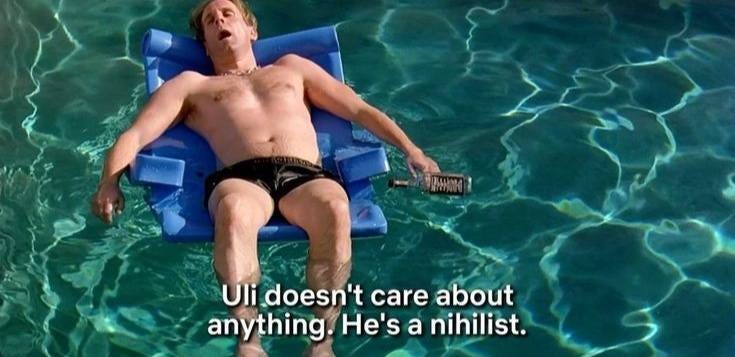
It simply means that there is a way to mitigate, or possibly even eliminate, the exhaustion of constant self management. Less monitoring, self-optimization, performance, narration of productivity.
It means when confronted with the next challenge, question, dilemma, or existential frustration - simply don’t worry about how to change it. Roll with it. Let it unfurl on its own.
You don’t need to add energy to the wheel that is already turning.
Is this difficult? Yes.
Am I “trying” to finish writing this article? Yes.
Is that changing anything? Not really.
And, it’s not that the article will finish itself….
It’s that the harder I push, the worse the writing gets. Put differently, in the words of Lao Tzu, “effortless action” - acting in accordance with the grain of things - might get you even greater outcomes than you might otherwise have expected.
So, what does that mean for you?
Here’s an invitation - pick one thing you can simply let happen in the next month or two. And when the itch to grab back onto the steering wheel creeps up - try to re-commit to not holding on.
Have something to say? Send me a note here.

→ Let me know which topics, challenges or thinkers I should write about next - Reply or comment and tell me what you’d love to learn more about.
→ Connect with me on LinkedIn - I share more thoughts like these there.
This resonates AND Kat got me an Oliver Burkeman book, Meditation for Mortals, for Christmas, so there’s that! Was already a fan and now we are reading the book together
Happy new year! I'm a big fan of your writing, and this one especially hit the nail on the head. Thank you!